The FBI’s 2025 IC3 Elder Fraud Report shows staggering losses. Here’s what changed, what it means, and what you can do today.
Every year, the FBI’s Internet Crime Complaint Center (IC3) releases data on fraud targeting older Americans. Every year, we hope to see the numbers level off. And every year, they don’t.
The 2025 report is the most alarming yet.
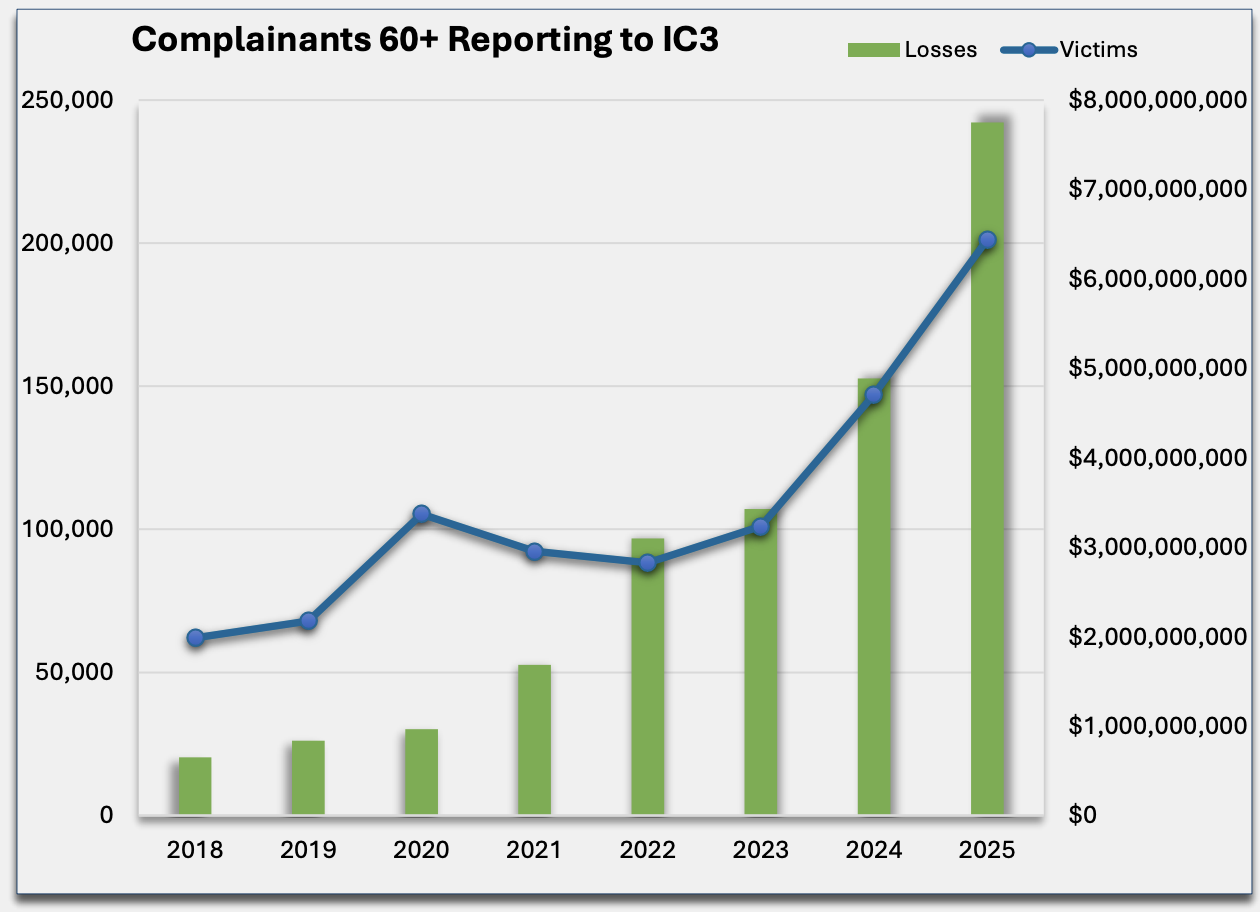
Complaints filed by 60+: 201,266 (↑ 37% from 2024)
Total losses: $7.75B (↑ 59% from 2024)
Average loss per victim: $38,500 per complainant
Lost over $100K: 12,444 individuals
Losses to elder fraud nearly doubled in a single year. From $4.9 billion in 2024 to $7.75 billion in 2025. This is not a slow-moving problem.
What’s driving this surge?
The data points to a few crime types exploding in scale. Investment fraud was the single largest category of losses — over $3.5 billion — nearly double 2024’s figures. Tech and customer support scams cost seniors over $1 billion, as fraudsters posed as Apple, Microsoft, and bank representatives to drain accounts. Government impersonation scams (fake calls from the Social Security Administration or the IRS) topped $413 million, up 99% from the year before.
Phishing complaints more than doubled, and AI-enabled fraud, a category newly tracked in 2025, already accounts for over $352 million in losses and 3,143 complaints. Criminals are using synthetic voices and deepfake video to impersonate grandchildren, bank officials, and government agents in ways that are genuinely difficult to detect.
Cryptocurrency remained the payment method of choice for scammers, with losses surpassing $4.3 billion, which is a $1.5 billion increase in a single year.
Why these numbers understate the real harm
Every statistic above comes only from complaints that were actually reported. Research consistently shows that fraud – especially fraud targeting older adults – is massively underreported, often due to embarrassment, confusion, or not knowing where to turn. The true scale of this crisis is almost certainly much larger.
And behind every data point is a person. A retired teacher. A widowed parent. Someone who spent decades building savings that disappeared in a single phone call. An average loss of $38,500 is, for many seniors, months or years of retirement income… Gone.
This is solvable — with awareness
At opt-inspire, we believe the most powerful protection isn’t technology; it’s a trusted human in a senior’s life who takes 15 minutes to have a real conversation. Most fraud succeeds because victims feel alone in the moment. They don’t feel empowered to pause, hang up, or ask for help.
You can change that for someone you love. You don’t need to be a cybersecurity expert. You just need to care enough to start the conversation.
Two things you can do right now
You don’t have to do everything; just one of these today makes a difference.
→ Learn how to volunteer with Opt-Inspire by presenting in your local community
→ Receive an Opt-Inspire conversation guide to use with someone you care about
Statistics sourced from the FBI Internet Crime Complaint Center (IC3) 2025 Annual Report, Elder Fraud section.