Tag: online safety

  • The Numbers Are In — and They Should Alarm All of Us

    The Numbers Are In — and They Should Alarm All of Us

    The FBI’s 2025 IC3 Elder Fraud Report shows staggering losses. Here’s what changed, what it means, and what you can do today.

    Every year, the FBI’s Internet Crime Complaint Center (IC3) releases data on fraud targeting older Americans. Every year, we hope to see the numbers level off. And every year, they don’t.

    The 2025 report is the most alarming yet.

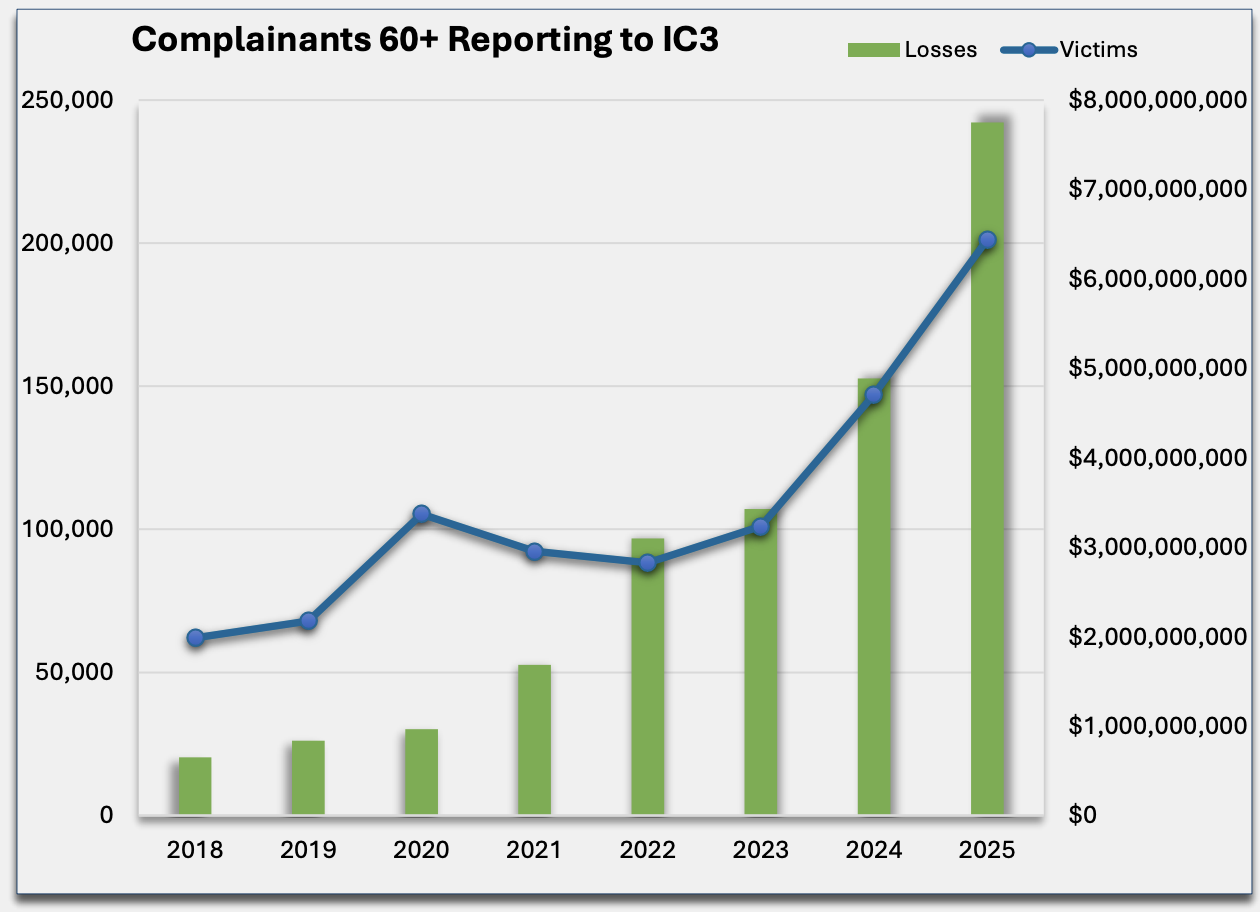
    Complaints filed by 60+: 201,266 (↑ 37% from 2024)

    Total losses: $7.75B (↑ 59% from 2024)

    Average loss per victim: $38,500 per complainant

    Lost over $100K: 12,444 individuals

    Losses to elder fraud nearly doubled in a single year. From $4.9 billion in 2024 to $7.75 billion in 2025. This is not a slow-moving problem.

    What’s driving this surge?

    The data points to a few crime types exploding in scale. Investment fraud was the single largest category of losses — over $3.5 billion — nearly double 2024’s figures. Tech and customer support scams cost seniors over $1 billion, as fraudsters posed as Apple, Microsoft, and bank representatives to drain accounts. Government impersonation scams (fake calls from the Social Security Administration or the IRS) topped $413 million, up 99% from the year before.

    Phishing complaints more than doubled, and AI-enabled fraud, a category newly tracked in 2025, already accounts for over $352 million in losses and 3,143 complaints. Criminals are using synthetic voices and deepfake video to impersonate grandchildren, bank officials, and government agents in ways that are genuinely difficult to detect.

    Cryptocurrency remained the payment method of choice for scammers, with losses surpassing $4.3 billion, which is a $1.5 billion increase in a single year.

    Why these numbers understate the real harm

    Every statistic above comes only from complaints that were actually reported. Research consistently shows that fraud – especially fraud targeting older adults – is massively underreported, often due to embarrassment, confusion, or not knowing where to turn. The true scale of this crisis is almost certainly much larger.

    And behind every data point is a person. A retired teacher. A widowed parent. Someone who spent decades building savings that disappeared in a single phone call. An average loss of $38,500 is, for many seniors, months or years of retirement income… Gone.

    This is solvable — with awareness

    At opt-inspire, we believe the most powerful protection isn’t technology; it’s a trusted human in a senior’s life who takes 15 minutes to have a real conversation. Most fraud succeeds because victims feel alone in the moment. They don’t feel empowered to pause, hang up, or ask for help.

    You can change that for someone you love. You don’t need to be a cybersecurity expert. You just need to care enough to start the conversation.


    Two things you can do right now

    You don’t have to do everything; just one of these today makes a difference.

    → Learn how to volunteer with Opt-Inspire by presenting in your local community

    → Receive an Opt-Inspire conversation guide to use with someone you care about


    Statistics sourced from the FBI Internet Crime Complaint Center (IC3) 2025 Annual Report, Elder Fraud section.


  • Do You Have a Personal Incident Response Plan? How To Build One in 15 Minutes.

    Do You Have a Personal Incident Response Plan? How To Build One in 15 Minutes.

    By Opt-Inspire Board Members, Justin Daniels & Alexandria Lutz

    If you discovered right now that your bank account was compromised, would you know exactly what to do first?

    Most people would not. In a digital crisis, adrenaline runs high and clarity drops fast.

    At Opt-Inspire, we recommend every household maintain a simple, physical Personal Incident Response Plan. This is a short checklist you can reach even if your phone, email, or computer is compromised.

    Take 15 minutes tonight to complete the steps below. Print the plan and keep it in a central location, such as on the refrigerator or in a drawer, where it can be accessed quickly.


    1. Immediate Actions: Stop & Secure

    If you suspect a scam, hack, or unauthorized access, take these steps immediately:

    1. STOP.
      Hang up the phone or close the chat. Do not continue the conversation.
    2. PROTECT.
      Do not click links, download files, or install software.
    3. VERIFY.
      Contact your bank or service provider using a trusted number, such as the phone number printed on your card or official statement. Do not use numbers sent to you by text or email.
    4. RESET.
      Change passwords for any account you believe may have been targeted. Start with email, banking, and financial accounts.

    2. Your Critical Response Table

    Complete this section with your family. Do not write full passwords here.

    Contact or Information NeededDetails
    Bank Fraud Department Phone (fill in)
    Credit Freeze Status (check when complete)☐ Equifax ☐ Experian
    ☐ TransUnion
    Emergency Tech Contact (fill in the person you will call first)
    Primary Email Provider (fill in)
    Cell Phone Carrier PIN (fill in)
    (To stop SIM swapping.)

    3. Reporting and Recovery Resources

    If an incident occurs, these organizations provide free, expert assistance:

    ResourceDetails
    AARP Fraud Watch877-908-3360 (Free support for all ages)
    IdentityTheft.govThe FTC’s official recovery site
    Local Police: Non-Emergency
    (Add your local number)

    How to Use This Plan

    • The 15-Minute Meeting.
      Sit down with loved ones and review & complete the plan together. This is not about fear. It is about preparation.
    • The Safety Net Role.
      Designate one person as the “first call” (third box under #2, above). Their job is not to fix everything, but to slow things down and provide a calm second opinion.
    • The Physical Copy (Print It!).
      Digital notes are useful until you are locked out of your devices. Paper still works when technology fails. A physical plan cannot be encrypted, deleted, or held hostage.

    Stay safe, stay savvy, and remember: you are not alone.

  • Is This All a Simulation? What Sora 2 Means for Truth, Trust, and Families

    Is This All a Simulation? What Sora 2 Means for Truth, Trust, and Families

    By Alexandria (Lexi) Lutz

    The latest generative video tool from OpenAI, Sora 2, is no longer a far-flung experiment. It’s here. And it’s rewriting what “seeing is believing” means.

    In a striking move earlier today, OpenAI paused its ability to generate videos of Dr. Martin Luther King Jr. The joint statement released on X by OpenAI and King Estate, Inc. stated, “[s]ome users generated disrespectful depictions of Dr. King’s image. So at King, Inc.’s request, OpenAI has paused generations depicting Dr. King as it strengthens guardrails for historical figures.”

    Within hours of Sora 2’s public launch on September 30, 2025, AI videos depicting mass shootings, war zones, and racial violence proliferated online.

    Why Awareness Is Your Most Powerful Tool

    It’s easy to think: “that’s interesting tech news, but not for me.” But Sora 2 and its peers don’t just exist on the edges. They’ll soon be embedded into everyday digital life. How?

    1. Real → Synthetic = Weaponized Illusion

    One recent CBS News profile put it bluntly: “Anybody with a keyboard and internet connection will be able to create a video of anybody saying or doing anything they want.”

    That means someone might generate a convincing video of “your loved one” saying something they never did – demanding money, confessing guilt, or making false medical claims.

    In AI research themselves, security scholars at Cornell demonstrated that “jailbreak” attacks can trick text-to-video systems into producing violent, hateful, or shocking content, bypassing safety filters. So even content moderation “rules” may be brittle.

    2. Reputation, Legacy & Identity at Stake

    Legal experts have sounded alarms: Sora 2 has enabled hyperrealistic depictions of deceased public figures in abusive or surreal settings, like AI versions of Robin Williams or Amy Winehouse used in bizarre, disrespectful scenes. One Guardian piece described these as “legacies condensed to AI slop.”

    This isn’t just about celebrities. If synthetic replicas of anyone’s likeness can be manufactured and circulated (especially posthumously), what does control of identity mean in the digital age?

    3. Public Perception & Social Trust Unraveling

    In a recent academic study, researchers collected 292 public comments on social media about Sora 2 and found consistent anxiety about “blurred boundaries between real and fake, human autonomy, data privacy, copyright issues, and environmental impact.” One commenter noted:

    you don’t know what’s real now.... If you’re taking anything you see in the mainstream media at face value, then idk what to tell you. 99% of it is spin, bias, or even flat out wrong.

    This is no small concern for the people trying to safeguard truth in families.

    The New Digital Reality Check for Families

    You don’t need to be a tech expert, but there are practical, immediate actions to take:

    • Don’t trust every “video.” Sora 2 can make hyper-real scenes of anyone — verify through a real call or text before reacting.
    • Guard your image. Limit what family videos or photos you share online; they can train or appear in future AI tools.
    • Pause on emotion. Scammers may use lifelike AI clips to create panic or urgency — slow down before you respond.
    • Stay AI-aware. Follow trusted updates, stay informed through known sources , and share what you learn with loved ones.

    Holding On to Truth When Everything Looks Real

    These new risks show that digital safety is no longer optional even for non-tech users. The people we aim to protect (seniors, children, caregivers) face an accelerating threat landscape.

    So at Opt-Inspire, we are dedicated to broadening our role to ensure our education for seniors and children includes what deepfakes look like, and how to question and verify them, as well as cultivating communities that share stories, warn each other, and build resilience in real time.

    In the coming years, it won’t be enough for individuals to fend for themselves. Our legal, technological, and social must carry some of the load. We can’t wait until harm happens.

    That’s why we welcome you to join the movement to protect the ones you love. How can you do that? It’s simple: forward this article to someone you care about, or get more involved in what we’re doing by visiting us at optinspire.org.

  • From Rotary Phones to Robots: What Everyone Should Know About U.S. Online Privacy Laws

    From Rotary Phones to Robots: What Everyone Should Know About U.S. Online Privacy Laws

    This is Not Legal Advice (But Hopefully Very Helpful!)
    This post, inspired by research conducted by Opt-Inspire Founding Board Member, Justin Daniels, is meant to guide and inform, not to give you formal legal advice. (Think of it as sitting down for coffee with a lawyer friend who promises not to speak in legalese.)

    Why This Matters

    If you’ve ever felt like the internet is one giant game of “gotcha,” you’re not alone. Seniors are some of the most frequent targets of scams, fraud, and misinformation online, but really, it affects all of us. Whether you’re 17 or 77, we’re navigating an online world built on laws that predate smartphones, Google, and social media.

    Every pop-up ad, text message, or surprise phone call can feel like a trap. That’s why it helps to know what protections exist under U.S. law (and where the gaps are). Spoiler alert: the laws we currently have in place weren’t designed for the world we live in now.


    Privacy & Security in the U.S.

    Here’s the reality: unlike Europe, which has a powerful, one-size-fits-all privacy law called the GDPR, the United States has no single national privacy law. Instead, it’s a patchwork quilt. Several states have strong protections. For example, in California, you can ask companies what data they have about you, demand that they delete it, and even stop them from selling it.

    But move across state lines, and your rights might look completely different. As of the date of this post, nineteen states now have their own privacy laws in effect, but the details vary, and most of the country still doesn’t have broad protections. At the federal level, there are only narrow laws covering specific areas like health records (HIPAA), bank information (GLBA), or children under 13 online (COPPA). For adults using Facebook, Google, or YouTube? There’s no broad federal law keeping your data safe.


    The Old Internet Law That Shaped Big Tech

    Back in 1996 (when most people were just getting used to dial-up internet), Congress passed the Telecommunications Act. Buried inside was a short section with a big impact: Section 230.

    This law basically says that online platforms aren’t legally responsible for what users post. If a newspaper prints something false, it can be sued. But if someone posts something false on Facebook, Facebook itself isn’t liable. At the time, this seemed like common sense; it was written for small online forums, not for billion-dollar companies.

    Fast forward to today, and tech giants like Google and Meta have used Section 230 as a shield. It has allowed them to grow massively without being legally responsible for the endless stream of content on their platforms. Some argue this protects free speech and innovation. Others believe it lets platforms dodge accountability for scams, lies, and harmful material.


    Artificial Intelligence: The New Wild West

    As if the internet weren’t complicated enough, now artificial intelligence (AI) has entered the scene. Congress has held hearings, but so far there’s no national law regulating AI. A few states (like California, Colorado, and Utah) have started to pass rules. New York City has even required audits of AI used in hiring. But most states haven’t taken action that will move the needle.

    The problem is speed: AI is moving far faster than lawmakers. Deepfake videos, fake voices that can mimic your loved ones, and AI-powered chatbots that run scams are already here. Laws, meanwhile, are still playing catch-up.


    What All of Us Should Keep in Mind

    So where does that leave you? The truth is, your level of protection depends a lot on where you live. Don’t assume Google or Meta will catch scams for you. They aren’t legally required to. And when it comes to AI, you should be extra skeptical. If a phone call, email, or video feels even a little “off,” trust your gut.

    The best defense right now is good digital habits: use strong passwords, ignore links from strangers, and never give out personal information unless you’ve initiated the contact with a legitimate source, or if you’re absolutely sure who’s asking.


    Main Takeaways

    The laws that still shape our online lives were written before smartphones, before Google, and long before artificial intelligence. Section 230, once meant for tiny chat rooms, became the shield for Big Tech. Meanwhile, AI is racing ahead, creating risks lawmakers haven’t yet caught up with.

    Until stronger protections are in place, awareness and caution are your best allies. Stay alert, stay curious, and most of all: stay safe out there.